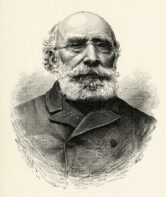
Two new Bechamp pages
Two new Antoine Bechamp pages have been added ….. an image gallery, and a complete bibliography of his works.
Two new Antoine Bechamp pages have been added ….. an image gallery, and a complete bibliography of his works.

READER REVIEW
...after hearing the news from USA about the 32 vaccinations to which inhabitants by law are forced go get, I ordered this book, and I must say that it totally turned upside-down my knowledge of Pasteur and vaccines...
-
VIDEO LINK
In episode 1 of this series, Mike Winner recounts what he learned from reading 'Béchamp or Pasteur?', and some discoveries were made and discussed.
In Part 2, Dr. Lando takes over to give us the full download on the history of the Germ Theory conspiracy and why geniuses like Antoine Béchamp have been erased from what used to be mandatory curriculum in Biology 101. How this omission keeps most doctors in the dark about our true biological nature and how it perpetuates the current runaway train we call Western medicine.
Alfa Vedic is an off-grid agriculture & health co-op focused on developing products, media & educational platforms for the betterment of our world.
These discussions are based on the book Béchamp or Pasteur? A Lost Chapter In The History Of Biology, by Ethel Hume.
-
Article - Dr Robert Young
Dr Young discusses the way in which history and academia have accepted the germ theory, and treated Bechamp and pleomorphism so shabbily.
“There is no medical doctrine as potentially dangerous as a partial truth implemented as whole truth.”
In this account of one of his experiments which demonstrates the existence of microzymas, Bechamp added chalk to maintain the neutrality of the medium. He was surprised to see two different reactions, depending on whether he used chemically pure calcium carbonate or commercial chalk, all other factors being equal.
The first solution, with sugar added and treated with creosote, did not ferment.
The second solution, under the same conditions, fermented.
On microscopic examination of the commercial chalk, Bechamp invariably found the "little bodies" observed in his previous experiments. "They are organized and living", they act like moulds, they are agents of fermentation -- they are 'micro-leavens'.
by Robert Pearson
Introduction to Bechamp or Pasteur?
Pearson's book, originally published in the 1940's, is an excellent introduction to the theory and practice of Pasteur's 'science', his inability to fully understand the concepts he was appropriating, and the consequences of the vaccines that he and his followers created.
Louis Pasteur built his reputation and altered the course of twentieth century science by plagiarizing and distorting the work Antoine Bechamp.
Pearson exposes facts concerning Pasteur which are still being ignored today, and provides a detailed historical background to the current controversy surrounding vaccination. Even during Pasteur's lifetime, there were people who could see how wrong he was, and that he knew he was wrong.
Book extract
Bechamp's preface to 'The Blood and its Third Element'.This work upon the blood is the crown to a collection of works upon ferments and fermentation, spontaneous generation, albuminoid substances, organization, physiology and general pathology which I have pursued without relaxation since 1854, at the same time with other researches of pure chemistry more or less directly related to them, and, it must be added, in the midst of a thousand difficulties raised up by relentless opponents from all sides, especially whence I least expected them.
To solve some very delicate problems I had to create new methods of research and of physiological, chemical and anatomical analysis. Ever since 1857 these researches have been directed by a precise design to a determined end: the enunciation of a new doctrine regarding organization and life.
It led to the microzymian theory of the living organization, which has led to the discovery of the true nature of blood by that of its third anatomical element, and, at last, to a rational, natural explanation of the phenomenon called its spontaneous coagulation.
Bechamp, Rife and Naessens all demonstrated that there are cellular components which are virtually indestructible. Neither carbonizing temperatures nor radioactive radiation can harm them.
Enderlein believed that they entered the cells of higher differentiated cell colonies as parasites, while Antoine Bechamp believed that they are the essence of life in the cell.
The endobiont is always present, and cannot be removed from the living cell; the clinical symptoms of a disease depend on the stage of its development. This 'fungal parasite' can be present in all tissues and organs.
R. Pearson
Extract from the book 'Bechamp or Pasteur?'
In any discussion of the value of a remedy or preventative for any disease, actual statistics of the results that have followed the use of such remedy or preventative in the past should be of great value in judging it, especially when the trend over a long period of years can be charted graphically.
Hence it seems proper to consider what a chart showing the death rates both before and after the introduction of some of these biological treatments, might indicate; especially when the results can be compared with the general trend following other methods of treatment of more or less similar diseases.
For this reason, this chapter contains several charts showing the death rates of several diseases both before and after the use of biologicals, as well as some of the death-rates of similar diseases with and without the use of biologicals.
Book extract
From 'Bechamp or Pasteur?'Ethel Hume describes the origin of the cult of the germ theory of disease. It was at the beginning of 1873 that Pasteur was elected by a majority of one vote to a place among the Free Associates of the Academy of Medicine. His ambition had indeed spurred him to open ‘a new era in medical physiology and pathology’, but it would seem to have been unfortunate for the world that instead of putting forward the fuller teaching of Béchamp, he fell back upon the cruder ideas now widely known as the ‘germ theory’ of disease.
It was at the beginning of 1873 that Pasteur was elected by a majority of one vote to a place among the Free Associates of the Academy of Medicine. His ambition had indeed spurred him to open ‘a new era in medical physiology and pathology’, but it would seem to have been unfortunate for the world that instead of putting forward the fuller teaching of Béchamp he fell back upon the cruder ideas now widely known as the ‘germ theory’ of disease.
Book extract.
Introductory and historical notes from 'The Blood and its Third Element'. The object of this work is the solution of a problem of the first order; to show the real nature of the blood, and to demonstrate the character of its organization. It has, besides, a secondary purpose; the solution of a problem long ago stated, but never solved – the cause of its coagulation, correctly regarded as spontaneous, after it has issued from the blood vessels.
The conclusion arrived at is that the blood is a flowing tissue, spontaneously alterable in the same manner as are all other tissues withdrawn from the animal, coagulation of the blood being only the first phase of its spontaneous change.
Article from the Life Enthusiast
"...all natural organic matters (matters that once lived), absolutely protected from atmospheric germs, invariably and spontaneously alter and ferment, because they necessarily and inherently contain within themselves the agents of their spontaneous alteration, digestion, dissolution".
These agents are of course the self same Protits of Enderlein. As noted, Béchamp called them Microzymas. He proved that all animal and plant cells contain these tiny particles which continue to live after the death of the organism and out of which microorganisms can develop. In his book Mycrozymas, Béchamp laid the foundation for the concept of pleomorphism...."
BOOK - paperback and epub
Béchamp or Pasteur? is the explosive classic that challenges the foundations of modern medicine.
Ethel Hume’s meticulous history argues that the Germ Theory of disease was built on the plagiarized and distorted work of Antoine Béchamp, a contemporary of Louis Pasteur.
This vital book presents the case for Béchamp’s "Terrain Theory" - that the health of the body (the terrain) is more critical than the presence of germs - and details the scientific and political rivalry that shaped biology for the next century.
BOOK - paperback and epub.
The Blood and its Third Element is Antoine Béchamp’s scientific magnum opus.
In this detailed work, the great French scientist presents the evidence for the microzyma—the microscopic 'third element' of the blood that he argued was the true unit of life. This book provides the rigorous experimental data behind the Terrain Theory, challenging the foundations of Pasteur's germ theory.
This is a crucial text for understanding the biological mechanism of disease, fermentation, and life itself.
-