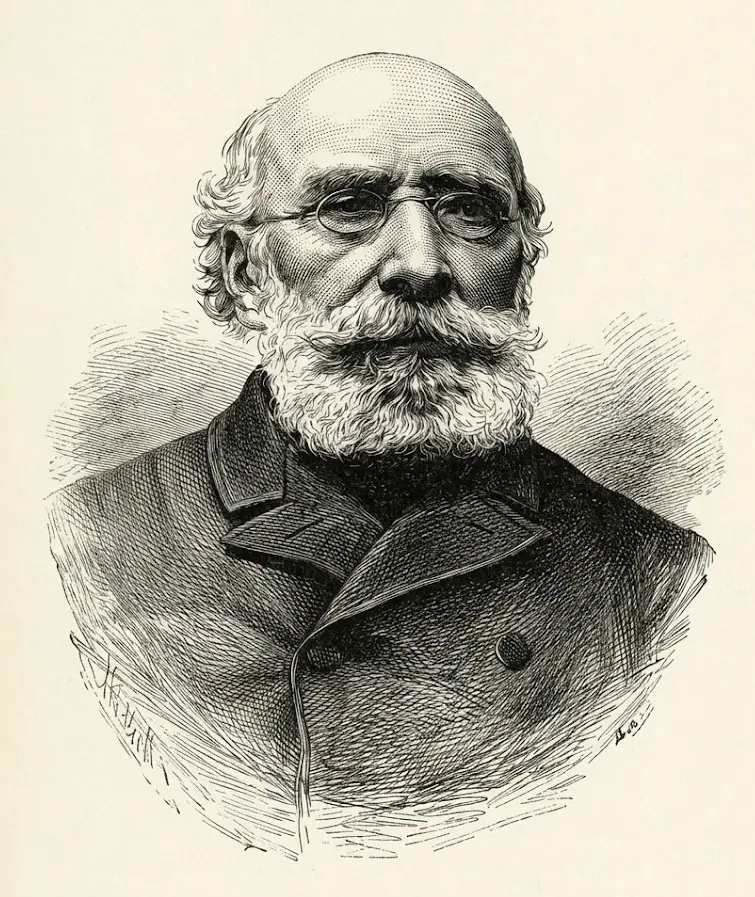
Early Life and Education (1816–1853)
• 1816: Born on October 15 in Bassing (Meurthe), France. He was the son of Jacques Béchamp, a miller, and Marie Catherine Antoine.
• 1822–1827: Around the age of six or seven, he moved to Bucharest, Romania, to live with his uncle, a French diplomat, who oversaw his education.
• 1831: Began a pharmacy apprenticeship under Ignaz Mausel in Bucharest.
• 1834: Following his uncle’s death from cholera, Béchamp returned to France,. He carried a certificate from Mausel dated May 25, 1834, describing him as an “exceptional subject”.
• 1834–1843: He registered at the École Supérieure de Pharmacie in Strasbourg while working at a pharmacy in Benfeld to support himself.
• 1840–1842: Served as préparateur (assistant) of chemistry at the Faculty of Sciences in Strasbourg,.
• 1843: Received his diploma as a Pharmacist (first class) in Strasbourg on August 11,.
• 1843: Married Clémentine Mertian on August 20 in Benfeld,. They would have four children.
• 1848: Published a political pamphlet titled The Secretary of the Ex-Committee of Christian Democracy to the 46,000 Voters Who Answered His Call.
• 1851: Appointed Professeur Agrégé (Fellow) at the School of Pharmacy in Strasbourg after submitting his thesis On Atmospheric Air,.
• 1852: Achieved the Licentiate in Physical Sciences.
• 1853: Obtained his Doctorate of Physical Sciences with a thesis on Pyroxylin (gun-cotton), which he dedicated to Louis Pasteur (then a colleague at Strasbourg) as a sign of “gratitude and admiration”,.
Scientific Breakthroughs at Strasbourg (1854–1856)
• 1854: Discovered a method to reduce nitrobenzene into aniline using iron filings and acetic acid,. This discovery lowered the cost of aniline significantly, founding the modern synthetic dye industry,.
• 1854–1855: Conducted the “Beacon Experiment”, proving that moulds appearing in sugar solutions were not spontaneous but airborne, and that they caused sugar inversion,.
• 1855: Published On the Influence That Pure or Salt-Charged Water Exerts on Cane Sugar in the Cold.
• 1856: Received his Doctorate of Medicine with a thesis titled Essay on Albuminoid Substances and their Transformation into Urea,. This work challenged the prevailing view that all proteins were a single substance.
The Montpellier Period (1857–1876)
• 1857: Appointed Professor of Medical Chemistry and Pharmacy at the Faculty of Medicine in Montpellier,.
• 1858: Published the full memoir of the “Beacon Experiment,” asserting that fermentation is due to living organisms (moulds) derived from the air, countering the theory of spontaneous generation,.
• 1860: Demonstrated that the synthesis of fuchsine (a red dye) could be achieved using arsenic acid.
• 1863: Published Lessons on Vinous Fermentation and Wine Making, arguing that fermentation is a nutritive act of a living organism.
• 1864: Read Memoir on Fermentation by Organized Ferments to the Academy of Science; he was the first to use the word zymase to designate soluble ferments (enzymes),.
• 1865: Discovered “little bodies” in chalk and milk capable of fermentation, which he later asserted were living organisms,.
• 1865: Began studying the silkworm disease (pébrine) at his own expense. He identified it as a parasitic disease and recommended creosote as a preventative,.
• 1866: Officially named the “little bodies” he discovered Microzymas (specifically Microzyma cretae in chalk),.
• 1867: Identified a second silkworm disease, Flacherie, describing it as a constitutional “microzymian disease” rather than a parasitic one,.
• 1869: Published On the Fermentation of Alcohol by the Microzymas of the Liver, asserting that fermentation is a normal physiological function of living tissues.
• 1870: Named a Chevalier of the Legion of Honour,.
• 1872: Engaged in a priority dispute with Pasteur regarding the origin of yeast on grapes; Béchamp and Estor claimed they had established the principle years prior,.
• 1873: Published research on the microzymas of the urine.
• 1874: Ernest Baltus (Béchamp’s student) defended his thesis Théorie du microzyma.
The Lille Period (1876–1888)
• 1876: Appointed Dean of the Free Faculty of Medicine at the Catholic University of Lille,. He moved there with his son, Joseph.
• 1881: Attended the International Medical Congress in London, where a public altercation occurred with Pasteur regarding the validity of the microzymian theory versus the germ theory,.
• 1883: Published his magnum opus, Les Microzymas, synthesizing thirty years of research and refuting the “panspermia” (germ theory) of Pasteur.
• 1885: Death of his wife, Clémentine Béchamp, on May 28.
• 1886–1888: Experienced severe administrative conflicts at Lille. He was accused of teaching “materialism” due to his scientific views.
• 1888: His time at Lille ended in resignation/dismissal. His son Joseph filed a lawsuit against the university regarding the violation of contracts,.
Final Years in Le Havre and Paris (1888–1908)
• 1888: Moved to Le Havre and purchased a pharmacy and laboratory in association with his son, Joseph,.
• 1893: Death of his son, Joseph Béchamp, on March 1, at age 44.
• 1893: Moved to Paris. He was given space to work in the laboratory of Charles Friedel at the Sorbonne,.
• 1899: Published The Blood and its Third Element at the age of 83, arguing that blood is a flowing tissue containing microzymas essential for coagulation,.
• 1900: Published Louis Pasteur, His Chemico-Physiological and Medical Plagiarisms, a polemic detailing his grievances regarding priority and scientific credit.
• 1902: Death of his younger son, Donat Béchamp.
• 1908: Antoine Béchamp died on April 15 in Paris at the age of 91,.
• 1908: An obituary appeared in Nature (May 7), acknowledging him as a link between the “new chemistry” and the old.
Posthumous
• 1927: A monument featuring a bronze bust of Béchamp was inaugurated in his birthplace, Bassing, on September 18.
• 1944: His grandson, Dr. Georges Béchamp (son of Donat), died in a prison cell in Saigon on July 20, having served as a Consul for Free France.